
Corporate Water Stewardship Overview
Water is one of our most valuable resources, and we all have a role to play in safeguarding it. Corporate Water Stewardship (CWS) plays an important role in protecting our water — but what is CWS? In this month’s blog, we break down what it is, why it matters, and ways we’re getting involved.
Corporate Water Stewardship Overview
Corporate Water Stewardship (CWS) is a commitment and timeline set by a corporation to replenish a defined volume of water within the watershed(s) they operate in. Any interested corporation can invest in CWS, and any group can propose a project — as long as no other corporation claims the water benefit. Some examples for targets include being water neutral or water positive by 2030 or replenishing 120% of water consumption by 2035. The Great Outdoors Foundation (GOF) is developing a portfolio of water quality-focused CWS investments, focusing on three main project types: nature-based solutions, agricultural solutions, and infrastructure solutions.
Replenishment
As connected to CWS, replenishment typically refers to funding or completing projects that add new, measurable water and co-benefits within a set timeframe that would otherwise not be restored. To be the most effective, replenishment projects should aim to address shared water issues in a defined watershed. How replenishment is activated looks different for every project. Some projects, such as restoring wetlands, provide an immediately visible water benefit, impacting both quality and quantity. Others, like converting row crop to pasture, require a closer look to see how deeper-rooted vegetation is replenishing groundwater, improving soil health, and benefitting water quality.
Reporting
Reporting is crucial for CWS projects. While a project can provide environmental co-benefits that are not directly impacting water quantity, like increasing biodiversity or preventing soil loss, a successful CWS strategy requires accurate water quantity reporting. Without it, it becomes difficult to confidently say how an investment is contributing to a CWS goal.
Project designers and engineers use the Volumetric Water Benefit Accounting (VWBA) to calculate the replenishment outcomes from each project. This standardized, science-based methodology is used to measure, track, and report positive water volume impacts. After a project’s completion, multiple years of monitoring and reporting occur with the project partner. Data is collected annually to show the net increase of water volume sustained throughout the years.
Why does CWS matter?
Every conservation action, whether big or small, matters. CWS actions help balance a corporation’s water use, supporting projects that restore water and improve water quality to the same watershed or basin where they’re located. Water can be restored at many different points in the hydraulic cycle, through things like aquifer recharge, groundwater and instream flow improvements, stormwater capture, wastewater reuse, or other natural and engineered methods.
How we’re engaging in CWS
Nonprofit organizations, like GOF, provide a preferred pathway for CWS project ideation, design, and presentation due to our ability to deploy impact-based funds and a working history of similar projects. GOF is proud to engage in CWS, helping identify and leverage millions of dollars for replenishment and water quality projects. Below are a few examples of ways we’re participating in CWS across Iowa.
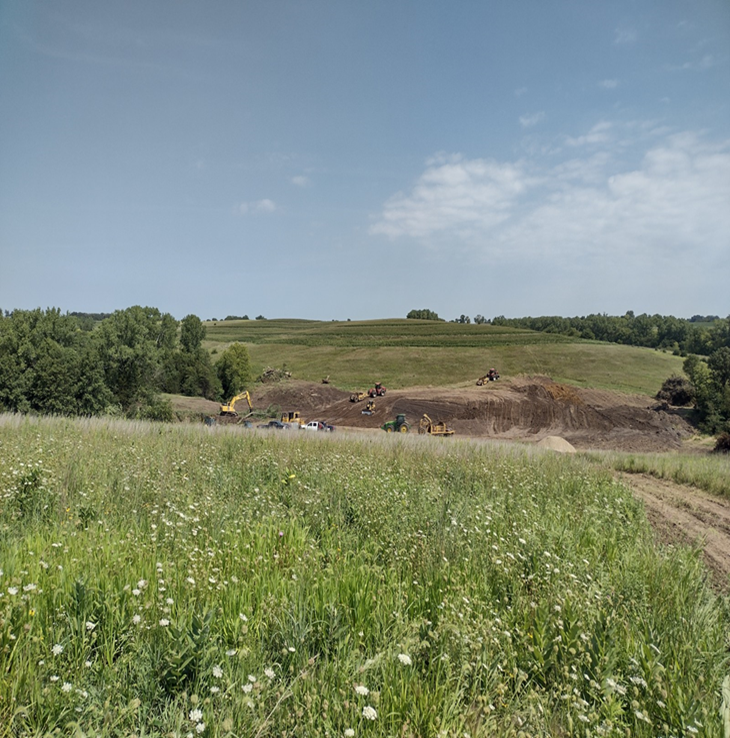
Grade stabilizations being built in Southwest Iowa
Southwest Iowa Grade Stabilization Structures
In Southwest Iowa, a portfolio of grade stabilization projects brought conservation improvements to nearly 50 sites. Grade stabilization structures help slow down fast-moving runoff on agricultural fields, which can be detrimental to soil and water quality. Every grade stabilization project utilizes different techniques, with these sites using ‘stairs’ to slow down water as it cascades off the sloped land.
These structures are designed to reduce soil erosion, reduce sediment load into water bodies, and improve downstream water quality by capturing runoff from adjacent land. These 47 site grade stabilization structures will mitigate 1,853,850 pounds of total lifetime nitrates. We are grateful for Google’s CWS commitment to our Conservation Acceleration Fund (CAF), which joined project support from the Iowa Department of Agriculture & Land Stewardship, Drake University, and local Soil and Water Conservation Districts.
Polk County Chichaqua Pumped Wetland
Iowa’s landscape used to be speckled with wetlands, covering 4 to 6 million acres. Now, nearly 95% of those wetlands have been drained. At Chichaqua Bottoms Greenbelt, Central Iowa’s largest outdoor recreational area, efforts are being made to reverse this.
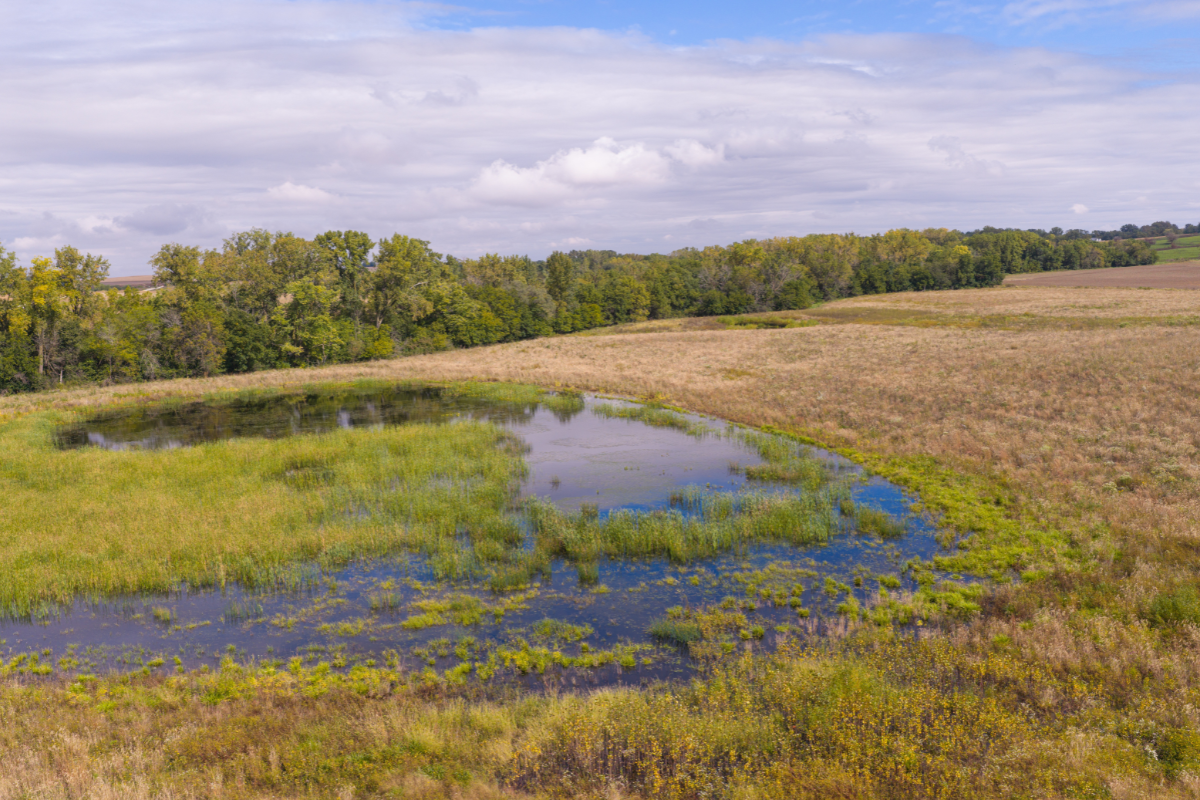
Wetlands at Chichaqua
Utilizing a pump system, this project draws water from agriculture drainage ditches to rehydrate two disconnected wetlands. Wetlands have incredible water quality and quantity benefits, often referred to as the Earth’s ‘kidneys’. The area also includes a new two-stage demonstration ditch, used to educate and inform on the benefits of the engineered design. These structures will capture 14,455 acres of agricultural drainage, with an impressive 8,500,250 pounds of nitrates mitigated in the project’s lifetime.
This CAF project was supported through Meta’s CWS investments, alongside generous funding from Iowa Department of Agriculture & Land Stewardship, and Polk County Public Works.
We all have a role to play in advancing water quality, and we are thankful to corporations who are helping ensure healthier tomorrows through CWS investments. To learn more about CWS with the Great Outdoors Foundation, please visit our webpage.